

Ten Steps to Better Shifting
Louisville Bicycle Club's Bike Maintenance Class
by Duc M. DoRear Derailleur
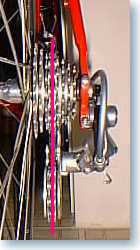
- Make sure the rear derailleur is not bent from a crash or the bike having fallen over. If it is, you need professional help — take it to a bike shop. Generally, the two pulleys should line up vertically. Make sure the cable is not binding in its housing, or where it passes through the guide on the bottom bracket shell. A light oil helps inhibiting rust and improves friction.
- Shift the chain to the smallest sprocket and make sure that it's the last detent (click). Take up the cable slack by loosening the anchor bolt and pull the cable taut. Adjust the high limit screw to prevent the derailleur from moving too far and dropping the chain between the cog and the rear dropout.
- Shift the chain to the largest sprocket. Adjust the low limit screw to prevent the derailleur from going too far and hit the spokes.
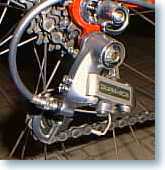
- Shift to the middle sprocket. Adjust the cable tension by turning the barrel adjuster. Turn it counterclockwise (looking at the derailleur from behind) to increase tension to improve the downshift to larger sprockets. Conversely, turn it clockwise to decrease the tension to improve the upshift to smaller sprockets.
Hint: while turning the crank, turn the barrel adjuster counterclockwise (to move toward the larger cog) until the chain makes rubbing noises, then turn the barrel adjuster clockwise one-half to three-quarters turn to center the pulleys. The chain should be silent at this point.
- Repeat steps 2–4 until the following are achieved:
- the chain is not overshifted off the smallest sprocket
- the derailleur does not touch the spokes when shifting to the largest sprocket
- equal ease of shifting either up or down the gears
Front Derailleur
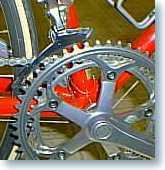
- Make sure the front derailleur cage is parallel to the chainrings and has the proper clearance between the outer cage and the large chainring. Generally, this clearance should be 1-2 mm. Adjust the derailleur mount if necessary for alignment and clearance. Make sure the cable is not binding in its cable housing, or where it passes through the guide on the bottom bracket shell. A light oil helps inhibiting rust and improves friction.
- Shift to the smallest chainring and make sure the shifter is at the last detent or against the stop. Take up the cable slack by loosening the anchor bolt and pull the cable taut.
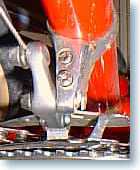
- Shift the rear derailleur to move the chain to the largest sprocket. Adjust the low limit screw so that the inner plate is about 1 mm from the chain. Make sure the chain doesn't rub against the cage as the crank is turned. A larger gap is required if the chain rubs in spots.
- Shift the rear derailleur to the smallest sprocket. Shift the front derailleur to the largest chainring. Adjust the high limit screw to allow the derailleur to push the chain onto the largest chainring but not so far to drop it off on the outside. Make sure the right crank does not strike the derailleur cage as it turns.
- Repeat steps 7–9 until:
- the chain is not overshifted in either direction (adjust limit screws to prevent this); and
- there's enough derailleur travel to push the chain to all chainrings.
Things you can do to keep your shifting the best it can be:
- Learn to shift.
- Keep the chain clean and lubed.
- Keep the derailleurs clean.
- Lightly lubricate the pivots on the derailleurs. Overdoing it is almost as bad as not lubricating it at all. The extra lube tends to accumulate dirt and grime — the enemy of clean shifting.
- Lightly lubricate the cable where it runs inside the cable housing only if there's increased friction due to rust forming on the cable.
- Always lean the bike against its right side to protect the exposed rear derailleur in case the bike falls over. If you have to lay the bike down, lay it down on its left side, again to protect the rear derailleur.
Copyright ©1997-2000 Louisville Wheelmen. All rights reserved.
Web posted: 17 March 1997
last updated: 12 June 2000
Please contact the webmaster if there's any problem regarding this page.